ON THE COVER Clearing Out the Noise
Home > Life Style > About Town
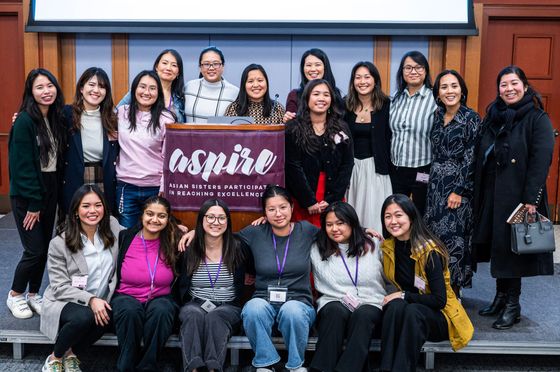
Inspiration Point ASPIRE honors an amazing young woman at their annual Asian American Women in Leadership Conference.

Photo courtesy of Lisa D. Shah.

Nonprofit mentoring organization ASPIRE (Asian Sisters Participating in Reaching Excellence) held its 2008 Asian American Women in Leadership (AAWIL) Conference on April 26 at Harvard University. Celebrating the theme of “Balanced Leadership: Maintaining Perspective,” the conference featured a diverse panel of speakers who shared their experiences in developing and maintaining balance in their professional and personal lives.

At the conference, ASPIRE presented its first annual ASPIRE Outstanding Woman of the Year award to Mihiri Tillakaratne. Tillkaratne, 21, a junior at Harvard College, is the founder and executive director of Empower a Village (empoweravillage.org), a nonprofit organization dedicated to serving rural communities to Sri Lanka. In addition to organizing breast cancer awareness workshops, mobile eye clinics, and English and computer literacy programs in rural Sri Lanka, the Sri Lankan American also acts as a liaison between government and villagers. In 2006, the Sri Lankan American was awarded with a scholarship from L' Oréal Paris as part of Teen People' s feature “20 Teens Who Will Change the World 2006.”

Other nominees for the award included Neha Singhal, 20, Gaithersburg, Md., Asian American teen empowerment (first runner-up); Linda Chu, 21, of Monterey Park, Calif., Los Angeles community activist (second runner-up); Stephanie Drenka, 22, Southlake, Texas, comfort women awareness; and Jessie Pan, 17, New York, N.Y., New York City Chinatown youth activist.

Here, Tillakaratne gives us an inside look into what inspires her.


Q. How did you get involved with Empower A Village?


Mihiri Tillakaratne: I was 8 years old, and the executive director of Sarvodaya, which is the largest NGO in Sri Lanka, was staying at my home in Los Angeles. And he was showing me his picture album of all the photography he did with kids. I had been to Sri Lanka about twice before then, and I had visited my father' s village, and I had seen what the kids there had to deal with. And it had just been my birthday, so I had all this birthday money. So I went to him with my peanut butter jar of birthday money, and I told him, “Here. Can you help build a preschool in my father' s village?” And so he did! So after that we got involved with the eyeglasses project, where we work with optometrists in Los Angeles. They donate all their used eyeglasses that they don' t need anymore, and we take them to Sri Lanka.

I took over in about 2000, when I was 13. I wanted to start this English language/ exchange program. So I started working with urban Sri Lankan students, taking them into the villages, and seeing how fellow Sri Lankans, who didn' t have as many opportunities as they had, lived and making those connections.


Q. You received the 2006 Teen People Award for your work in tsunami relief. How did you get involved with that?


MT: At my temple, right after the tsunami, we gathered a couple 100 people. And most everyone was just shell-shocked, because a lot of people had lost loved ones, or they didn' t know what was going on. So I created a chart and said, “Alright. Let' s start with donations.” That' s how it started: a folding table outside my temple a day or two after the tsunami.

I essentially lived at the temple for two months or so — talking to people from the media, going to school, doing fundraising, working on press releases, trying to raise awareness. My angle for fundraising was to go to the schools, and talk to the students about the work that I did in Sri Lanka with children in the tsunami-affected areas. The students here got really inspired and involved, and we started doing bake sales and book drives. The next thing I knew, we' d raised over $20,000. Overall, through the temple tsunami relief fund, we raised about $300,000 to rebuild homes.
 

Q. What' s your journey been since then?

MT: Well, in 2005, I received a NetAid Global Action Award, which was $5,000 to put to any cause. In my case, I wanted to sponsor a water project and build wells for about 300 families in a cluster of three villages in the north central provinces of Sri Lanka. So I used that money to help get it started. In 2006, I got to see a couple of the wells they built, and it was amazing — water everywhere, and sanitation as well.

Also, in 2006, my mother' s cousin died of breast cancer — actually, my family has a history of breast cancer. After her death, we took a regular pamphlet on breast cancer and translated it to Sinhalese with pictures on how women could examine themselves for lumps. And then we went out into different villages to give workshops to educate women on what signs to look out for. A couple of weeks after the workshops, I actually found out that two of the women found lumps that they wouldn' t have found if they hadn' t been educated about it — they got the help they needed and now they' re fine.


Q. In terms of support, who do you go to? Who mentors you?


Actually, what usually happens is we go, we mess up horribly, and we learn from it. It' s a continuous process of, “Oh wait, I shouldn' t have taught that concept that way to the kids,” or, “That workshop could have gone better.” We' re a group of people, friends and family, and we all get really excited about an idea, and we' ll jump in and just do the best we can. And a lot of times we' ll make mistakes, but that' s life — and we just accept it, we move on, and we do it better the next time.


Q. It seems to me that you' re not easily discouraged.


MT: I' m open to change. If you go into a situation thinking that it' s going to be a certain way, you' re going to be disappointed. I like being open to change, and being able to take a step back, and say, “What could I have done better,” not, “What did I do wrong?”


Q. What do you do with your summers now?


MT: I go to Sri Lanka! For the past couple of summers, I' ve been a counselor for the National Teen Leadership Program in Sacramento, which is an amazing program where I teach high school students how to be leaders. And I' m also a part of NetAid, which is now Mercy Corps. As a senior in high school, I was a part of their pilot program called Global Citizen Corps, where they gave students the resources to educate their peers on issues such as HIV/AIDS, access to education, women' s issues, etc. So now I get to use all those mistakes that I' ve made, and give back and educate others that are in the GCC community.


Q. It sounds like you' re insanely busy. 


MT: I am! I' m busy, but I enjoy doing what I' m doing. It' s not like, “I have this, and I have that, and I have to do it all.” Something even as mundane as classes — I take classes that I want to take. I take courses that inspire me. It' s not a chore — it' s more of, “I have all these things that I get to do, and it' s all really exciting!”


Q. Do you feel like you have role models?


MT: My parents have always been about doing what makes you happy — in a healthy way of course. They' re totally my role models! They understand that life is about balance, and they have their priorities straight. They know that life is about relationships, and things like your friends and baking. Just being around things and people that make you genuinely happy, as opposed to, “I have to get this promotion,” or “I' m not making enough money,” or “I have to get an A+ in all my classes.” It' s not about that — and that' s what' s really kept me grounded.


Q. How do you feel about being thought of as a role model?


MT: It' s scary! I' m young and I don' t have a lot of life experience. But at the same time, it' s very flattering. And it puts a little bit of pressure on me to be a better person. I don' t like labels; it' s very embarrassing when I tell people about Teen People, and the Global Action Award, and the Outstanding Woman of the Year. I' d rather be a good person, a person who cares about the world, and who is self-aware and mature and funny and intelligent — instead of that label “the role model.”


Q. What advice do you have for girls that may want to get involved, but don' t know how?


MT: I always say this, but it' s true: Small actions make a big difference. I always tell young people that you don' t have to do this huge amazing thing — you can change the world with small steps. For example, organizing a book drive at your school, a fundraiser, a bake sale; those mean a lot. It' s not something huge and amazing and sexy, but it does get something done.

By Jennifer Chow

HOME | ABOUT US | SUBSCRIBE | ADVERTISE | CONTACT US | EMPLOYMENT 2007 © Copyright Audrey Magazine. All rights Reserved. Read Privacy Policy.

Designed by mindlinq.com